

Top Data Center Contractors in California: How to Choose the Right Builder in 2026


.png)
Planning a data center project in California takes careful thinking from the very beginning. The site, utility access, cooling plan, permitting path, equipment lead times, and construction budget all need to work together before a project can move forward with confidence.
That is why choosing the right data center contractors matters. A data center is a performance-driven building. It needs strong electrical planning, mechanical coordination, secure access, reliable backup systems, and a construction team that understands how every part of the project connects.
California throws a spanner in the works. Land can be scarce, electricity access can be delayed, energy expectations are high, and permitting timelines can impact the entire program. With this knowledge, the builder can help owners clearly analyze the project before money is wasted on the wrong things.
Element Homes approaches complex building projects with a planning-first mindset. Your existing blog already explains how data center costs are shaped by power, cooling, AI infrastructure, land, and long-term building performance, which gives this follow-up topic a strong foundation.
Why Data Center Contractors Matter in California

Choosing data center contractors in California should begin with one simple question: Can this team manage technical construction from planning through delivery? A data center is not a basic commercial shell. It is a facility built around power, heat, uptime, access, and future growth.
California projects need early coordination
Before building a data center, owners should consider site conditions, available electricity, municipal approvals, availability of equipment, deadlines, and mechanical demands from the utility. If these things are studied too late, the project can be delayed, need redesigning, and come under budget strain.
A strong planning process looks at:
- Electrical service capacity
- Backup power needs
- Cooling and mechanical systems
- Fiber and connectivity access
- Equipment staging and delivery
- Fire, safety, and code requirements
- Future expansion goals
This is why data center construction should start with feasibility, not only drawings.
Power access shapes the full project
Power is one of the biggest planning items for any data center. The project may need utility upgrades, transformer space, backup generation, switchgear, and room for future electrical capacity.
Good data center contractors review these questions early because power can affect the site choice, building layout, project cost, and construction schedule. If power is not available within the needed timeline, even a good site may not be the right fit.
What to Review Before You Build a Data Center
Before you build a data center, the project team should have a clear picture of the building’s purpose, performance goals, and technical needs. This helps reduce guesswork and gives the owner a better path for budgeting.
Site readiness and land use
The site must provide for the building, equipment yards, utility access, loading places, service roads, stormwater planning and future growth. Local permissions and zoning can also impact what gets developed and how quickly in California.
Experienced data center builders consider more than the building footprint; they look at the entire site. They think about how the equipment will go in, where the infrastructure will go, and how the project can grow later without big issues.
Utility and service planning
A data center depends on reliable service. Electrical capacity, water availability, backup systems, and connectivity should be reviewed before final site decisions are made.
This is where data center construction companies with strong planning habits can help owners avoid costly assumptions. The best approach is to identify service gaps before design and construction move too far ahead.
Key Parts of Data Center Construction
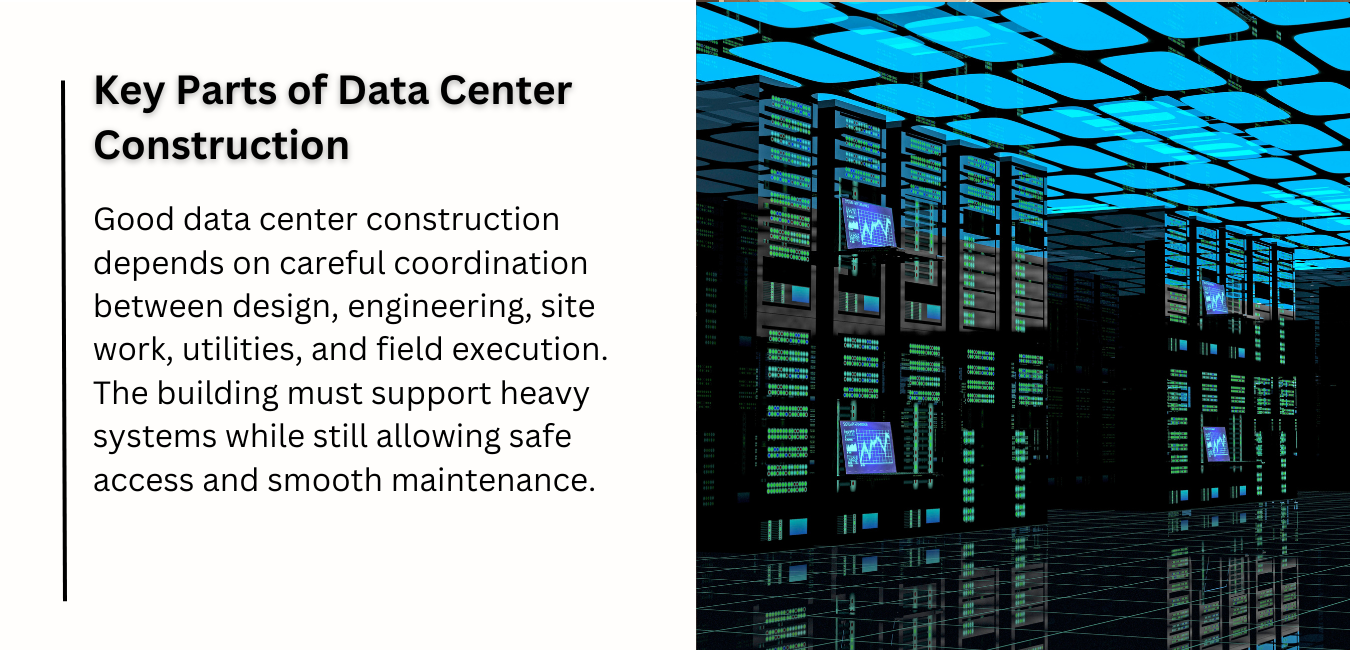
Good data center construction depends on careful coordination between design, engineering, site work, utilities, and field execution. The building must support heavy systems while still allowing safe access and smooth maintenance.
Electrical systems
Usually, electrical work is one of the most significant sections of the project. Data centers may require service, switchgear, UPS systems, generators, distribution paths, grounding, and redundancy planning at high capacity.
Because electrical equipment can have long lead times, strong data center contractors review procurement early. Waiting too long can affect the schedule and increase the cost risk.
Cooling and mechanical planning
Servers and AI equipment create heat. Cooling must be planned around density, equipment layout, airflow, energy use, maintenance access, and long-term operation.
This is one area where data center construction firms need to coordinate closely with mechanical engineers. The wrong cooling plan can affect performance, energy use, and the total budget.
Security and access
A data center must protect equipment, users, and operations. Access points, loading areas, perimeter planning, camera locations, controlled entries, and secure equipment paths should be reviewed early.
For owners comparing data center builders, security planning should be part of the construction conversation, not a late add-on.
Understanding the Cost to Build a Data Center
The cost to build a data center in California can vary widely because each project depends on power, cooling, land, equipment, density, permitting, labor, and future expansion. A small facility and a large AI-ready project will have very different cost structures.
Main cost drivers
Owners should expect the budget to be shaped by several major items:
- Site acquisition and preparation
- Utility upgrades
- Electrical infrastructure
- Mechanical and cooling systems
- Backup power
- Fire and life safety systems
- Security systems
- Labor and materials
- Permits and inspections
- Long-lead equipment
The cost to build a data center should be discussed during early planning so the owner understands where the largest budget pressure may come from.
Why early budgeting matters
A rough number without proper review can create false confidence. The real cost to build a data center becomes clearer when the builder studies the site, utility path, design goals, equipment needs, and construction schedule.
This is why owners should be careful when comparing data center construction companies based only on early estimates. The lowest number may not include the full scope needed for a reliable facility.
How to Choose a Data Center and Contractors

The best data center contractors are not chosen by price alone. They are chosen by their ability to plan, coordinate, communicate, and deliver a technical project with fewer surprises.
Review planning experience
Before selecting a builder, ask how the team handles preconstruction. A strong builder should be able to discuss site review, budget planning, equipment lead times, constructability, permitting, and schedule risks.
Useful questions include:
- How do you review utility access before construction?
- How do you plan around electrical equipment lead times?
- How do you coordinate cooling and mechanical systems?
- How do you control changes during construction?
- How do you support future expansion planning?
These questions help owners compare data center construction firms in a practical way.
Top USA Data Center Contractors and Builders to Consider in California
There is no single best contractor for every data center project. The companies below are worth researching based on their California presence, mission-critical experience, or ability to coordinate complex design-build planning. Before making a selection, owners should verify current availability, licensing, insurance, relevant project history, technical partners, safety performance, and experience with facilities of a similar size and power density.
1. Element Homes
Element Homes is a California design-build company focused on custom construction, development, and detailed project planning. Its planning-first approach, transparent pricing, and project coordination can be useful for owners evaluating high-performance buildings, complicated sites, or mixed-use development opportunities.
Because data centers require specialized electrical, mechanical, controls, security, redundancy, and commissioning expertise, owners should confirm the proposed technical team and mission-critical partners for the exact scope. Element Homes is therefore a company to include in early planning conversations when site strategy, budgeting, design coordination, and long-term building performance are priorities.
2. DPR Construction
DPR Construction has dedicated mission-critical teams and completed data center work in California, including a major CoreSite facility in Los Angeles. Owners may consider DPR for complex projects that require detailed preconstruction, cost modeling, phased delivery, technical coordination, and speed-to-market planning.
3. HITT Contracting
HITT Contracting’s Santa Clara team reports experience with hyperscale and colocation data centers across the Bay Area and beyond. The company is worth reviewing for Silicon Valley projects that need mission-critical construction knowledge, utility coordination, secure operations, and coordination among large technical teams.
4. Turner Construction
Turner Construction’s portfolio includes data center work in Silicon Valley. Owners may review Turner for large, technically intensive projects where electrical distribution, cooling, controls, equipment procurement, and construction management must remain closely coordinated.
5. Holder Construction
Holder Construction focuses on data and telecom facilities and maintains an office in San Jose. It may be considered for large, fast-paced projects where security, confidentiality, mechanical and electrical coordination, preconstruction, and design-build capabilities are important.
6. Clayco
Clayco has delivered data center construction in Santa Clara and operates a dedicated mission-critical business. Owners can consider the company for integrated design-build programs requiring architecture, engineering, construction, schedule predictability, and careful operational planning.
A shortlist should never be based on company size or marketing language alone. Owners should request relevant California project examples, references, proposed team resumes, preliminary schedules, procurement strategies, commissioning plans, and a clear explanation of how each builder will manage power, cooling, permitting, risk, and future expansion.
Look for clear communication
Data center projects involve many moving parts. Owners need a builder who can explain risks clearly, keep the team aligned, and give direct updates as decisions are made.
Reliable data center contractors should help the owner understand what is known, what is still being reviewed, and what could affect cost or schedule.
Why Element Homes Fits High-Performance Building Conversations

Element Homes is built around careful planning, custom construction, and strong project coordination in California. For owners researching data center contractors, the same planning values matter: clarity, structure, cost awareness, and long-term thinking.
Planning before construction
A successful complex build starts before the first major construction phase. The team should review the site, design goals, utility requirements, system needs, budget expectations, and timeline.
Element Homes brings this type of planning mindset into projects where details matter. That includes custom homes, advanced residential builds, mixed-use planning, and performance-focused construction.
Stronger coordination for complex systems
Modern buildings often need smarter systems, stronger electrical planning, better HVAC coordination, backup power, security, and future-ready infrastructure. These items affect walls, ceilings, service spaces, equipment rooms, and finish decisions.
The same disciplined thinking used in data center construction can help create cleaner planning for buildings that need to perform well for years.
Comparing Data Center Construction Companies the Right Way
When reviewing data center construction companies, owners should look beyond marketing language. The right choice should be based on project fit, planning quality, and technical understanding.
What separates a strong builder
A strong builder should help the owner understand the full project before construction begins. That means discussing land, utilities, permitting, design needs, system planning, budget, and schedule.
Key qualities include:
- Clear preconstruction process
- Strong site review
- Electrical and mechanical coordination
- Budget transparency
- Long-lead procurement planning
- Practical schedule guidance
- California construction knowledge
- Communication with engineers and consultants
These qualities matter because data center construction companies often deal with large budgets, strict timelines, and technical systems that must be coordinated in the right order.
Why project fit matters
Not every data center builder is the best fit for every project. Some projects may necessitate considerable utility planning. Others may need fast-track building, phased growth or sensitive work on a tight California site.
Homeowners need to choose a builder for what the project calls for, not for a blanket promise.
Working With Data Center Construction Firms in California
California construction requires patience, planning, and local awareness. Data center construction firms working in this market must understand how approvals, labor, utilities, and site limits affect the final result.
Permits and approvals
Permitting can influence the timeline from the beginning. Depending on the site and scope, the project may involve planning review, building permits, fire approvals, energy compliance, and utility coordination.
Strong data center construction firms help organize these steps so the owner has a clearer view of the process.
Schedule and procurement
Electrical and mechanical equipment can take time to source. This is why procurement planning should begin early. If major equipment is delayed, the whole project can be affected.
Before you build a data center, the team should review which materials or systems may need early decisions.
What Strong Data Center Builders Should Bring to the Project

The right data center builders bring structure to complicated decisions. They help the owner move from idea to practical plan by organizing the technical, financial, and construction details.
A complete project view
A builder should understand how the site, design, power, cooling, security, and budget work together. A decision in one area can affect another area quickly.
For example, cooling choices can affect power needs. Power needs can affect site layout. Site layout can affect cost. Cost can affect phasing. This is why data center builders should guide the planning conversation from the start.
Long-term building value
A data center should not be planned only for opening day. It should be planned for maintenance, upgrades, energy use, and future needs.
That same long-term thinking is valuable in all high-performance construction. Element Homes uses this approach when helping clients think through comfort, durability, systems, and future flexibility.
Conclusion
Choosing the right data center contractors in California starts with planning. Power access, cooling, permitting, site conditions, budget, equipment lead times, and future expansion all need to be reviewed before construction begins.
The best builder helps the owner understand the full picture before major decisions are locked in. That matters whether you are comparing data center construction companies, reviewing data center construction firms, speaking with data center builders, or trying to understand the real cost to build a data center.
For California owners planning a complex build, early coordination can save time, reduce confusion, and create a stronger final project. Contact Element Homes to discuss your construction goals, project needs, and next steps.
Frequently Asked Questions
What should I look for in data center contractors in California?
Find a constructor who understands power planning, cooling, site feasibility, utility access, permitting, cost control, construction sequencing, equipment lead times, and long-term performance.
How early should I involve a builder before I build a data center?
The builder should be consulted at the early planning or site assessment stage. “That helps to identify power limits, utility needs, budget risks, permit issues, and equipment timelines before things get too far down the road."
What affects the cost to build a data center?
The cost to build a data center is affected by land, power capacity, utility upgrades, cooling systems, electrical equipment, backup power, permits, labor, materials, security, and expansion planning.
Are data center construction companies different from regular commercial builders?
Yes. Data center construction companies need deeper experience with power, cooling, redundancy, equipment coordination, security, commissioning, and long-lead procurement.
Why is California a challenging place for data center construction?
California projects can face stringent permitting, high building costs, utility cooperation, restricted land, energy regulations and difficult site circumstances. Careful planning helps to avoid unnecessary delays.

Related POsts
Longevity Home Design: Key Features for a Healthier Luxury Custom Home
Explore longevity home design ideas for a healthier luxury custom home, from cleaner air and better lighting to wellness spaces and durable materials.
Read moreBuilding a Luxury Custom Home in Atherton: Costs, Permits, Timelines & Design
Planning a luxury custom home in Atherton? Learn about costs, permits, timelines, tree rules, design choices, and what to review before construction.
Read more